


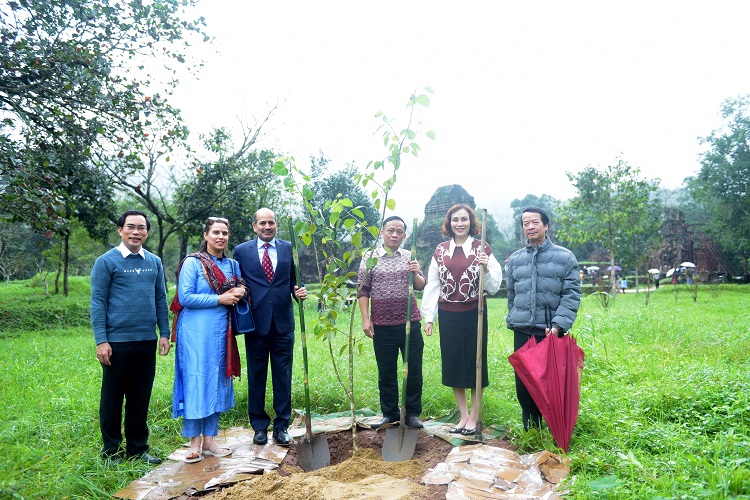
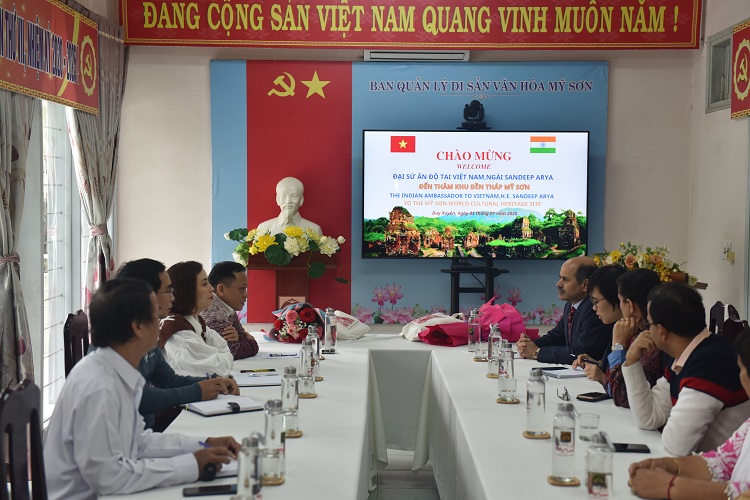
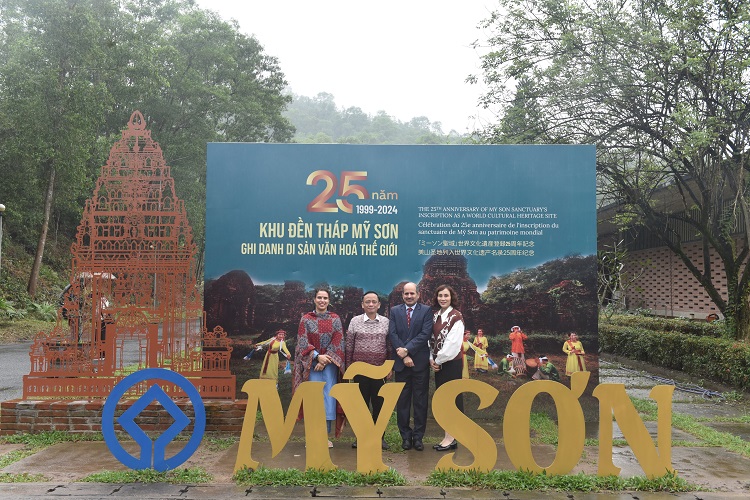
Sáng ngày 03/01/2025, Đại sứ Đặc mệnh toàn quyền Cộng hòa Ấn Độ tại Việt Nam, Ngài Sandeep Arya đến thăm và làm việc tại Khu đền tháp Mỹ Sơn. Tiếp Ngài Đại sứ cùng phu nhân, Ông Nguyễn Công Khiết - Giám đốc và Bà Văn Thị Cẩm Tú – Phó Giám đốc Ban Quản lý Di sản Văn hoá Mỹ Sơn đón tiếp và làm việc với đoàn. Nhân dịp đầu năm mới, Giám đốc Ban Quản lý gửi lời chúc tốt đẹp đến Ngài Đại sứ cùng phu nhân, đánh giá rất cao sự quan tâm của Ngài Đại sứ dành cho di sản Mỹ Sơn. Thể hiện qua việc tích cực thúc đẩy dự án hợp tác bảo tồn nhóm đền tháp F tại di tích Mỹ Sơn.
Ngài Đại sứ cảm ơn sự đón tiếp nồng ấm và trọng thị từ Ban Quản lý Di sản Văn hoá Mỹ Sơn, đánh giá cao sự hợp tác từ phía tỉnh Quảng Nam, trong đó làm việc trực tiếp và rất hiệu quả từ Ban Quản lý Di sản Văn hoá Mỹ Sơn để trùng tu thành công các nhóm A, H và K. Ngài Đại sứ cũng đề cập đến các vấn đề liên quan đến dự án hợp tác trùng tu nhóm F trong thời gian tới. Ông Nguyễn Công Khiết yêu cầu phía Đại sứ Ấn Độ tại Việt Nam tiếp tục hỗ trợ trùng tu các nhóm đền tháp còn trong tình trạng sau chiến tranh như nhóm E, F và A’. Ban Quản lý cũng yêu cầu có cuộc họp giữa các cơ quan liên quan giữa hai nước Việt Nam và Ấn Độ về dự án, đồng thời có các văn bản chính thức về dự án trước khi thực hiện.
Cần bảo tồn, trùng tu khẩn cấp nhóm F, Khu đền tháp Mỹ Sơn
Nhóm F là một trong những tổ hợp kiến trúc thờ Shiva giáo sớm, có niên đại từ thế kỷ 7-8 đến thế kỷ 10/11, là minh chứng quan trọng về quá trình phát triển kiến trúc, điêu khắc nghệ thuật ở Khu đền tháp Mỹ Sơn nói riêng và Champa nói chung. Tuy nhiên, hiện nay vẫn còn trong tình trạng đổ nát và vùi lấp, nhiều hố bom, vết đạn lỗ chỗ dù chiến tranh đã lùi xa gần 50 năm.
Theo tài liệu khảo sát của Henri Parmentier (1904) cho biết nhóm đền tháp F trước đây có 3 công trình gồm đền chính F1, tháp cổng F2, tháp phụ F3 và tường bao, hiện nay chỉ còn hai công trình F1 và F2, tháp F3 đã bị bom phá huỷ hoàn toàn. Trong đó tháp F1 là đền chính, tọa lạc ở trung tâm khu tháp F. Khu F nằm ở vị trí góc Đông Bắc thung lũng Mỹ Sơn, có mặt bằng kiến trúc nối liền và có chung tường bao với khu E tạo nên một tổ hợp thờ Shiva giáo tiêu biểu , đặc trưng tại Mỹ Sơn. Nhóm F đang trong tình trạng một phế tích kiến trúc khảo cổ học bị thời gian và chiến tranh tàn phá nặng nề, được khai quật trong khoảng thời gian năm 1903-04 bởi Viện Viễn Đông Bác Cổ Pháp và tái khai quật vào năm 2003 bởi Viện Khảo cổ học. Đền chính F1 có niên đại khoảng từ thế kỷ 8 đến thế kỷ 9, là một ngôi đền Hindu tiêu biểu thờ thần Shiva qua biểu tượng Linga –Yoni, phần mái đã sụp đổ hoàn toàn, thân tường chỉ còn cao từ 2 đến 4 mét nhưng trong tình trạng nứt vỡ, mất liên kết, biến dạng. Phần đế đền F1 cũng bị hư hoại nghiêm trọng, các trang trí chỉ còn vài dấu vết nhưng cho thấy những hoạ tiết tiêu biểu mang phong cách Hoà Lai và những ảnh hưởng từ các di tích khác. Gạch phần chân đế bị mủn và đang bị xâm thực, mất liên kết, phần đài thờ bên trong đã sập đổ hoàn toàn, hố thiêng đã bị xáo trộn và nhiều thành phần đài thờ nằm sâu dưới hố.
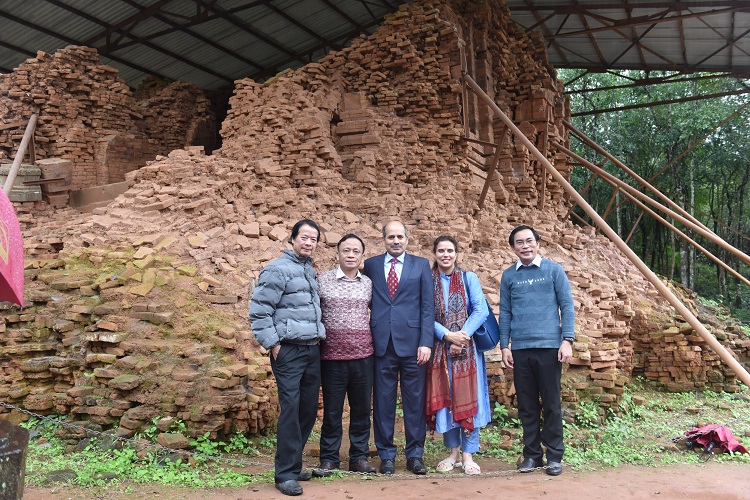
Nhóm F có lịch sử xây dựng từ thế kỷ 7, niên đại sớm trong tổng thể kiến trúc tại Khu đền tháp Mỹ Sơn, trải qua thời gian tồn tại và quên lãng trong rừng sâu với tác động của thiên nhiên, di tích xuống cấp, hầu hết các công trình bị sập đổ. Bên cạnh đó là hậu quả của chiến tranh, các phế tích đã bị huỷ hoại nghiêm trọng bởi bom đạn. Thêm nữa là việc khai quật khảo cổ học (năm 2003) nhưng không đi liền với trùng tu nên tình trạng di tích càng xuống cấp nghiêm trọng hơn. Để giải quyết tạm thời, chống sụp đổ thêm, BQL di sản Văn hóa Mỹ Sơn đã chống đỡ cấp thiết và làm nhà bao che đền F1 từ năm 2004 đến nay nhưng chỉ là giải pháp tạm thời. Tháp F1 có kỹ thuật xây dựng phần đến khác với hầu hết các đền tháp khác ở Mỹ Sơn, gạch chỉ xây lớp vỏ bên ngoài, phần lõi bên trong được nện chặt bởi đất, cát và sỏi, do đó dễ bị tác động bởi tự nhiên.
Cần có biện pháp khẩn cấp bảo tồn, trùng tu, tái định vị các thành phần kiến trúc còn lại của khu tháp F bao gồm các công trình đền F1, tháp cổng F2, dấu vết còn lại tháp F3, tường bao, khai quật và phát lộ các khu vực bên ngoài tường bao, hệ thống thoát nước, kè bờ suối phía Bắc khu F, hệ thống thoát nước. Sau khi trùng tu xong cần tháo dỡ nhà bao che tháp F1, bảo tồn cảnh quan khu F, duy tu bảo dưỡng định kỳ. Trong quá trình bảo tồn cần tái định vị lại đài thờ Mỹ Sơn F1 và bảo tồn các hố bom.
Văn Thọ
03 Tháng 1,2025
Chia sẽ mạng xã hội
- Nhiều hoạt động kỷ niệm 20 năm ngày UNESCO công nhận di sản Hội An, Mỹ Sơn (27.12.2019)
- Sáp nhập bảo tàng văn hóa Sa Huỳnh – Champa vào Mỹ Sơn (20.12.2018)
- Hội thảo khoa học: Quy trình kỹ thuật trùng tu đền tháp Chăm ở Mỹ Sơn (08.12.2018)
- Tổng thống Ấn Độ thăm Mỹ Sơn (19.11.2018)
- Khôi phục làng nghề dầu chổi Mỹ Sơn (07.11.2018)
- Nhiều sự kiện trong lễ Kỷ niệm 20 năm Mỹ Sơn được công nhận Di sản Văn hóa Thế giới (05.11.2019)


